One question stands at the forefront of the greatest controversies regarding Zionism which distinguished the Zionist movement from its many opponents in the world, and even created lines of division within Judaism itself: the question of religion and nationhood. The question regarding the nature of Judaism has accompanied the history of the people of Israel since the beginning of its journey. In an online lecture series he delivered for BAC, Dr. Assaf Malach returned to the days of the Return to Zion – when Jews who had been exiled to Babylon were allowed to return to Jerusalem after Persia conquered Babylon in the VI century BCE, as documented in the biblical books of Ezra and Nehemiah – to explore one of the interesting turning points in the eternal question: is Judaism a religion or a nation?
“The question of what is the place of the national-political element in the Bible is a big one,” says Malach. “On the one hand, the Bible is a very national text; it tells a national story about the history of the people of Israel. But the discourse on nationalism in the modern world doesn’t only deal with the nation in the ethnic sense, but mainly relates to the political story, to sovereignty and the need for a state, and one can ask to what extent, according to the Bible, the essence of the mission of the people of Israel is spiritual and to what extent it is bound up with a national, governmental, and sovereign idea that is part of the political history of the region. This is a truly open and tense question. On the one hand, we can find in the Bible texts that have national aspects concerning the present and future monarchy and that envision a renewed unification between the kingdoms: ‘My servant David shall be king over them’ (Ezekiel 37:24). On the other hand, we find in it anti-political texts that express the view that appointing a king or earthly sovereignty is rebellion against the kingdom of heaven, like that of Gideon, who says to the people ‘I will not rule over you myself, nor shall my son rule over you; God alone shall rule over you’ (Judges 8:23). Or as God expresses it when He says to Samuel after the people told him they want a king: ‘For it is not you that they have rejected; it is Me they have rejected as their king’ (1 Samuel 8:7). And also regarding the future to come, many prophets represent anti-political views and describe redemption as the rule of God alone, as Zechariah prophesies: ‘And God shall be sovereign over all the earth’ (Zechariah 14:9).
And what happens to this discussion specifically in the days of the Return to Zion?
“The days of the Return to Zion mark a very tense and interesting moment. On the one hand, after Cyrus’ declaration, the opportunity was created to return to the Land of Israel, and ostensibly this is an idea designed to restore Hebrew nationality and sovereignty; on the other hand, in practice, Jewish monarchy and sovereignty did not return throughout the 200 years of the Persian period, and the question is to what extent the Jews continued to dream about them and strive toward them.
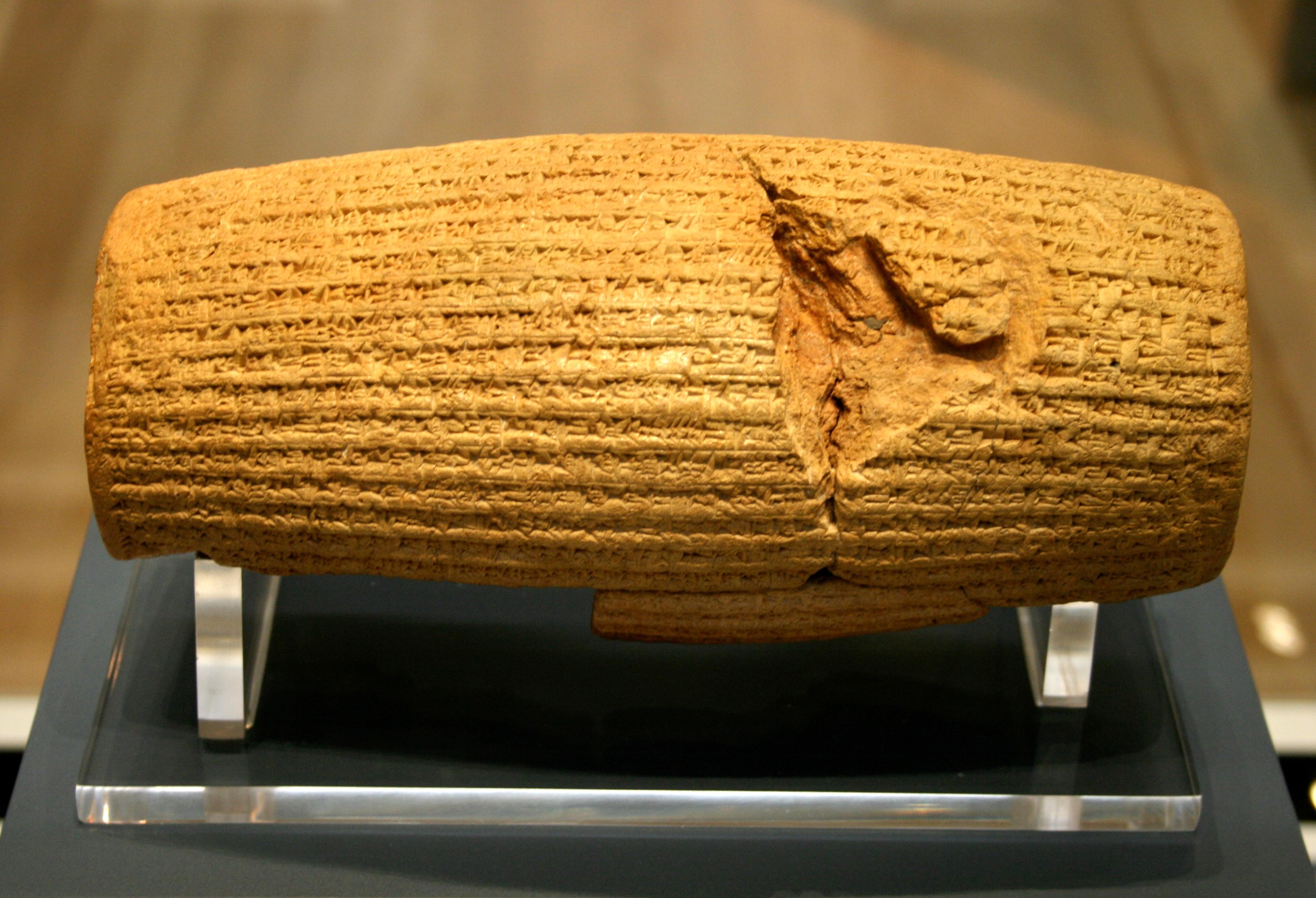
Photograph by Mike Peel (www.mikepeel.net). Modifications by مانفی- Cyrus cylinder
“Many scholars see the days of the Return to Zion as a period in which the people of Israel, following the destruction, transitions from being a political and sovereign nation to being a religious community focused on Temple worship or Torah study. Part of the people returned to the land and established a Jewish society, but in a new configuration, as a community that gave up national aspirations and essentially settles for a religious community living under foreign rule that allows it to maintain its religious way of life. The days of the Return to Zion are on the one hand the moment when there is a return to the Land of Israel, but on the other hand it raises the question of whether this return is a realization of the longing for renewed sovereignty or whether it is a renunciation of it in favor of establishing a religious community.”
Cyrus’ declaration was from the outset a religious event, wasn’t it? It allowed peoples to return to their temples.
“Indeed, what Cyrus said is that it’s possible to return to the land and build the Temple, and he even promised to finance the sacrifices and the worship of God in the Temple, but it’s hard to understand what actually was behind this declaration. The Babylonians exiled the peoples they conquered, and thereby weakened them. One can understand why stop the policy of exile, which requires a lot of governmental effort, but why return those who were already exiled? The answer that scholars suggest is that the Persians thought that through this method of return to the temples, they would create for themselves elites that would be loyal to Persian rule in exchange for the religious autonomy they would receive. The elites would manage the religious autonomies, collect taxes, and create loyalty. The dramatic question that emerges from here is whether the fact that this is what the Persian government wanted indicates that indeed the people of Israel gave up their national aspirations; whether they really didn’t want to recreate the days of the First Temple, but rather chose to focus on religious worship – and indeed, this is the moment of transformation of the Jews from a nation to a religious community – or whether given the circumstances, the returnees to Zion agreed to this deal with the Persians, but never forgot that from their perspective the ideal situation is to get rid of the Persians and achieve full realization of their dream through establishing a kingdom and renewing the rule of the House of David.”
Is this discussion a discussion among scholars or is it an internal discussion among the returnees to Zion?
“Both. This is a debate among scholars, some of whom greatly emphasized the reading that identifies the Return to Zion as a moment of giving up the national idea in Israel, and some of them, especially Zionist scholars, emphasized the alternative reading. But it’s hard to deny that not all the texts from the period of the Return to Zion hold the same view either. One can see texts that continue to dream about sovereignty. The prophet Haggai, for example, prophesies about a new world order – ‘And I will overturn the thrones of kingdoms and destroy the might of the kingdoms of the nations. I will overturn chariots and their drivers. Horses and their riders shall fall, each by the sword of his fellow’ (Haggai 2:22) – from which the kingdom of the House of David will sprout anew. One can also see hints of this in the Book of Ezra and in additional sources. On the other hand, we certainly also have places that downplay the national discussion and focus on the Temple. This debate continues throughout the Second Temple period: Is the Hasmonean revolt a religious revolt or a national one? After all, the Hasmonean revolt was driven by religious decrees, but could they alone have ignited it without national aspirations?”
This discussion is not just a historical or theoretical discussion. What are the implications of perceiving Judaism as a religion or as a nation in the modern era?
“Zionism led the national story of the Jewish people in the modern period, the national revival of the people of Israel in their land, and this view had, from its inception, opponents from within the Jewish people. When Herzl (1860 – 1904) spoke in Vienna about Zionism and established the First Zionist Congress, Jews of all types – religious, secular, liberal, Reform, and Orthodox – opposed him, because they didn’t accept the concept of Judaism as a nation. Reform Jews didn’t accept the idea and claimed that Judaism is a religion and not a nation, and therefore they clashed head-on with Zionism. Orthodox Jews also opposed. They claimed that the Messiah they were waiting for wasn’t flesh and blood in the image of Herzl or Ben-Gurion; the Messianic era would happen outside earthly history. The arguments that come both from the Orthodox world and from the liberal world say that Judaism was national, but transcended this in the Second Temple period and became a religion.
“Such claims are also made by some of Zionism’s haters and enemies. The Palestinian Charter says that Judaism is a religion and not a nation, and therefore has no national rights, and this is also what the Iranians claim regarding Zionism. This story – this claim that essentially the Jewish people have no rights because it is not a nation and shouldn’t be a nation – doesn’t leave us.
“In my view, whoever claims that Zionism falsified Judaism and that it has no national foundation goes too far because there is prominence of the national story already in the Bible. On the other hand, I don’t think that all Jews in all generations agree with the view that the place of nationality is very central in the history of Judaism or in its desired future. We have a whole world of Messianic dreams that are post-political, post-historical, that are apocalyptic and don’t dream of a Messianic future in which the people of Israel exists as a people among the peoples.
“We are required to have the ability to identify the different voices in different periods. In every era we can find the multiplicity of voices within the Jewish people regarding the centrality or non-centrality of the national story in the Jewish context in general, and in the context of redemption in particular. Precisely the awareness of this multiplicity of voices that exists within the Jewish people strengthens the fact that Zionism is an interpretive choice. There is no straight line leading from one who reads the Bible or from one who reads the words of the Sages of Israel in the Middle Ages to the Zionist movement. Zionism is a reasonable interpretive choice among existing voices, and this fact should arouse thought in whoever holds the Zionist position. It calls on them to ask themselves why they make the Zionist decision, what are its alternatives, what they gave up, and to whom they need to give an answer.”
For more, see Dr. Assaf Malach’s lectures (in Hebrew) in his series, “Judaism Between Religion and Nationality: A Biblical Study of the Roots of Modern Polemics.”
This article was originally published in Hebrew.
Main Photo: The delegates at the First Zionist Congress, held in Basel, Switzerland (1897)\ Wikipedia
Model.Data.ShopItem : 0
8